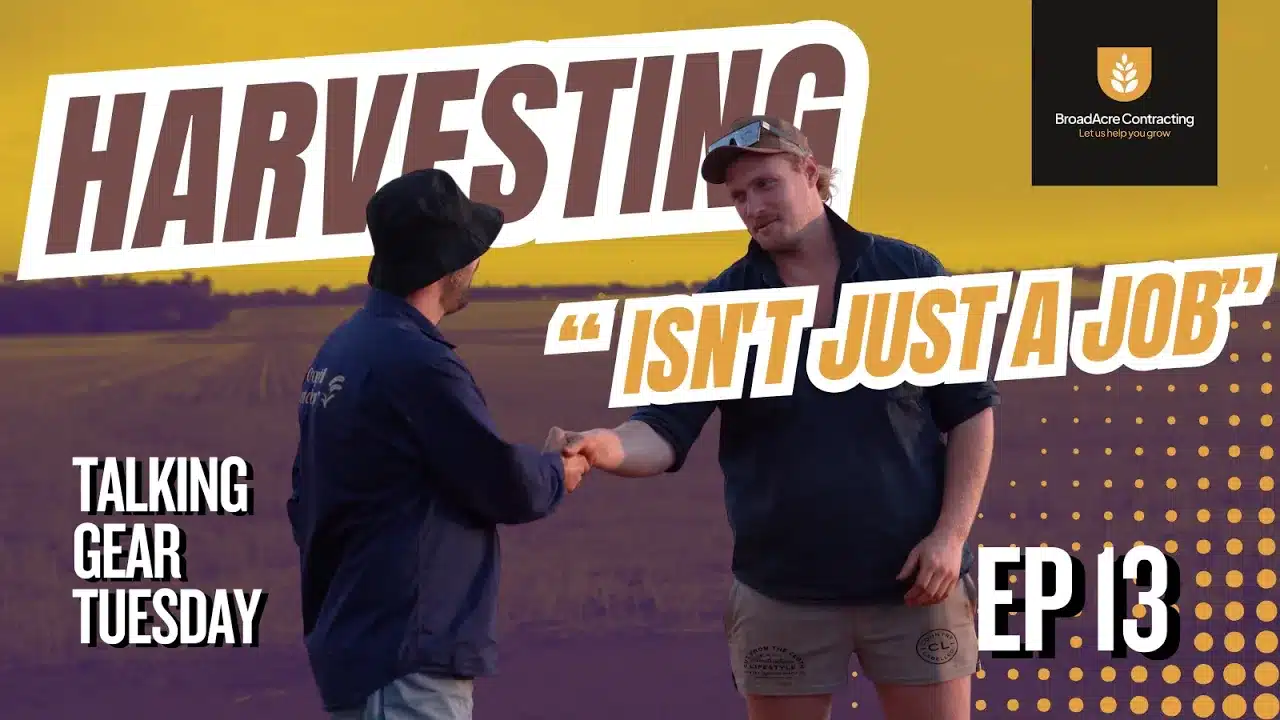
Talking Gear Tuesday EP27 returns to Cadell Earth & Ag to see Shaun Francis’s...


of Broadacre Contracting
Users Total Blog Posts:
Post created:
Unique Post Views:
Legends, hope your day is going alright.
But if you need my help, there is a possibility it probably is not.
Anyway, as the boys on the Catch My Drift podcast say, a problem shared is a problem halved.
So if you have had a breakdown, need to hire gear or find a contractor urgently, give Dillon at Broadacre Contracting a call on 0439 300 380.
We will solve your problem straight away.
We generally say we are available from 6am to 9pm, but honestly, if it is urgent, it is urgent.
If you have time and you are not in the paddock watching a front build up or chasing parts, feel free to make an account on the Broadacre Contracting website and do it yourself by going to My Account > New Tender Post > Post the job.
An instant alert will be sent out, and any available contractor can call you directly.
Make sure you come back to enjoy this yarn about something we all enjoy: harvesting and farm contracting.
Dillon Harrison from Broadacre Contracting is up in northern New South Wales catching up with Lachy Varley from LDV Agri Contracting.
The LDV team are based down home in the Finley and Tocumwal region in the southern Riverina, right on the Murray.
But like every harvest crew, they travel wherever the work takes them.
Today they are out in northern NSW and at the back end of their northern harvest run.
If you are not familiar with Finley and the Tocumwal region, it sits in the heart of the southern Riverina.
It is known for its irrigation country, and just up the road you will run into Berrigan, Deniliquin, Jerilderie and Mulwala, all a stone’s throw away really.
I do not want to start any blues here or start getting any unwanted phone calls, so I am not sure if I should say this, but I will.
It is some of the most productive mixed farming and irrigation country in the state.
Fair bit of moo chew getting grown around here as well as corn.
Lach runs a fairly diverse setup, from headers with Midwest and MacDon draper fronts, Unverferth chaser bins, Massey Ferguson HD square balers and MacDon mower conditioners and windrowers.
This bloke does paddock levelling with his chains, sowing, planting, harvesting, baling hay, windrowing, straw, the lot.
Today we are having a yarn about his gear, mainly the harvest gear, and we get a chance to learn his story and how a diverse operation like this hangs together.
There is a lot going on.
Bloody fair to say it is not for the faint-hearted.
So before we dive in, if you are a grower needing a hand with your sowing, baling or harvest program, or you are a contractor wanting to build your reputation and build relationships with growers, give Dillon a buzz on 0439 300 380 from 6am to 9pm.
Just a warning, he loves to have a yarn.
And if it is urgent, just ring, ring, and we will help in any way possible.
Let us yarn headers, mowers, windrowers and balers.
Lach comes from a red background.
He is a qualified diesel mechanic on the red stuff, so that is what he knows.
Plenty of experience on that front.
He also comes from a farming background and has always had a love for machinery.
He wanted to do this ever since he learnt how to drive tractors.
There are a few bloody solid things here.
Especially coming from being a qualified diesel mechanic with a background on the farm and a passion for machinery.
More often than not, we see contractors with experience maintaining gear from their farming background, but it is less common to see one who also holds a diesel mechanic qualification.
That is a big deal.
Having that combination of a passion for cropping and agriculture, backed by a diesel mechanic trade and actual diagnostic knowledge of the gear, is impressive.
I do not mean to sound like a broken record over and over, but when you are a harvest contractor, or I suppose any type of farm contractor, running out the back of Tamworth in some contour country and something goes astray, having the diesel mechanic trade and diagnostic ability is worth its weight in gold.
You are not parked up waiting three days on a dealer to get out.
You are under it yourself.
I put a dollar value on what it costs to be down every hour with a Class 8 header that is on around $650 a rotor hour.
It was $1,300 an hour, and on top of that, possibly losing the reputation of reliability.
If you are keen to have a gander at that, loop back to the Talking Gear Tuesday 12 yarn with Jimmy from Pitson Contracting.
There is also another yarn I did, and I am pretty sure it was the Episode 7 write-up where we really dived down the route of mechanics and having qualified diesel mechanics as the founders with the BB Harvesting yarn.
There is a trend here through all the episodes, and we have painted it fairly black and white.
Soon enough I will start to sound like a broken record, but here I go again.
If you want to be a harvest contractor or farm contractor, whether it is hay, silage, windrowing or whatever else, it is best to have some form of experience on the tools.
But as I say that, I think the answer is not necessarily being a mechanic as such.
It is being able to diagnose.
Anyone can be smart enough to smack some bushes out and put new ones in, but not everyone can diagnose.
So after all the preaching I have been doing, I am probably saying the wrong thing.
It is best to be able to diagnose and fix, not just be a mechanic as such.
So here is my question to the growers and contractors reading this.
The Broadacre Contracting community is widespread, but lately we have had a lot of growers and contractors from Tamworth through to Deniliquin, Jerilderie and right across our local district, the southern Riverina, come on board with us.
For the new growers and contractors, thanks for being involved.
We are here to support you every day and solve your problems.
But for you new lot and the rest of the Broadacre Contracting community Australia-wide, I want to put this one both ways.
Growers, when you are picking a contractor, how much of the conversation is around them being able to fix their own gear in the paddock and source local dealer parts?
Contractors, when you are picking a grower to work for, how much do you weigh up where they are located, their access to parts and dealers, and whether you can actually keep your gear rolling on their country?
Said it before, will say it again, been wrong a hundred times but I have also been right a hundred times. I reckon it matters more than most of us think, on both sides of the fence.
If you disagree, that is fine.
I would be keen to hear you tell me why.
I disagree with myself a lot, and I want to hear from you so I can learn.
LDV Agri Contracting runs a range of Class 8 headers and a couple of Class 9s as well.
They are running 12 metre MacDon draper platforms, and new to them this year is an 18 metre, 60-foot Midwest front.
At the time of filming, this was the first opportunity they had to play with it up in northern New South Wales.
Lach said it was really in its element.
They had found some good bonuses, picking up a bit of efficiency and really getting the most out of that Class 9 header.
A 60-foot Midwest draper on the front of a Class 9 would be getting across the hectares.
I want to take this opportunity to dive into the Midwest fronts.
If you have been around long enough, you will know Broadacre Contracting was built for the cropping and agriculture sector.
Simply put, we want to help growers’ and contractors’ bottom line.
We have a very transparent view on gear and everything.
Simply, we cannot be bought out to give a review, because we will not.
We can be paid to come out with a manufacturer and do some work, but they are going to be given the complete honest opinion.
We have spent years building our reputation and the respect we have in Australia, and we have done so by being honest and transparent.
Now I have got that out of the way, Midwest fronts.
I hear so many mixed reviews.
Some people swear by them, others would not go near one again.
I have been around one at harvest.
It was on a 9770 John Deere bullet rotor, a fairly simple platform, and we did not have too many issues with it.
That is the only experience I have with them myself.
From there I just hear about them a lot, and it is mixed reviews.
What I do like is they are an Australian company, based up in Dalby QLD I am pretty sure, and for me that is huge.
To exist and manufacture in Australia deserves a lot of respect, because Australian manufacturing is not cheap.
Staff costs, materials and everything else make it a serious effort.
I would love to hear your thoughts on Midwest fronts, but not just that.
I would love to know why I get such mixed reports.
I have asked people that exact question a lot, and I never seem to get the answer.
We are getting this mixed feedback not just from growers but from harvest contractors as well.
Midwest, if you ever come across this, we would love for you to get involved.
You could give us some unreal insights, and you could even get constructive feedback that could change the game.
After all, if we all work together, we could all achieve some impressive outcomes.
What I will say is hats off to you for keeping it in Australia.
Okay, that was a proper Dillon side mission to the max.
Moving on.
Throwing a 60-foot front on a Class 9 is a good way to go.
Put that extra horsepower to use.
Between the Class 8 and Class 9 Case flagships, the feeder house is identical and the rotor and cleaning space are much the same.
The grain tank?
I will be honest, I have had a few different conversations on this one.
On the current 250 series here in Australia, from what I can find, the 8 and 9 actually run the same tank, around 11 tonne of wheat.
The real difference is horsepower.
The Class 9 packs a fair bit more, and that is exactly why you would hang a 60-foot front off it.
On the chaser bin front, LDV Agri Contracting has a couple of 30 tonne chaser bins running on 300-plus horsepower front-wheel-assist tractors.
They are single axle bins with scales, lights and the standard kit you would expect.
They are Unverferth bins.
Lach said they are a great fit for the operation.
Coming from a pretty intense irrigation area down in the southern Riverina, they find themselves turning sharp.
Sometimes tandem bins can find themselves screwing pretty hard, with stub axles wearing and all that.
The single axle bins are very operator friendly.
You need a bit more experience in those larger bins.
They have been an incredibly good fit, letting LDV split machines up and set up smaller teams.
I have a lot of people call me often looking for advice.
They are wanting to break out of the wages cycle, or have already done that but just need a bit of guidance as they increase their risk.
It means a lot really, and I bloody enjoy these conversations.
It gives me a chance to listen to their thoughts and also an opportunity to guide them.
Please note, I am not a financial advisor and will not give financial advice.
Gamble responsibly.
A lot of the conversations are along the lines of, “I am looking to buy this gear, what do you think?”
Honestly, more often than not I am hearing blokes wanting to go into real big gear straight off the bat.
That makes me real nervous.
I am talking 500hp-plus tractors with bars and bins for sowing, or new, newish big headers.
I always suggest against doing things like that. Start small.
Buy a chaser bin.
They are hot real estate.
Do not let the syndrome of newest, flashest, biggest come in, because it will be the worst thing ever.
I bring this up because Lach said the chaser bins have been a really good fit, can split headers up, and can keep headers moving.
This is why chaser bins are a solid investment.
Hopefully now it makes sense why I rambled off up the top.
I want to use this time and this opportunity so the readers out there who are reading because they are looking at giving business in agriculture and broadacre cropping a crack, I can be of a positive impact to them.
If you want to talk or have a yarn around this, give me a bell.
My name is Dillon Harrison, I am available mostly from 6am to 9pm.
But if it is urgent, you are doey in the cab and the thought process about getting into business is what is keeping you going, I would be happy to help you.
Unfortunately, we used to give away thousands of dollars of trials, but we do not do that anymore.
Some businesses came in and used the $5k of free trials to get what they wanted and run away.
So I cannot help with that avenue like I used to.
I really did enjoy doing it, but it was not working.
That is irrelevant really.
It is the picking the phone up to yarn, to understand what it takes to be a harvest contractor, or a windrowing contractor, or any farm contractor really.
Well, I have to get out of this ramble because it is a proper side mission.
It is interesting to hear Lach and the LDV crew are running single axle bins.
Most people go the complete opposite direction nowadays.
So I am taking this opportunity to think about it and break it down.
Down around Finley, Tocumwal, Deniliquin and Jerilderie we have intense irrigation layouts, as Lach mentioned.
Channels, tight corners, point turns, even contours and the like.
Why single axle over a front and rear steerable axle bin?
Lach gave us his answer above.
They are a lot more operator friendly.
The trade-off is exactly what he flags.
Bigger tandem bins and larger gear need a more experienced operator, whereas these single axle 30 tonners are operator friendly.
As we all know, steerable axle bins need to be locked out before backing up or pulling out to send it up the road.
When reversing, the wheels cast right over to the stops, and if it is not locked out and you push it past the stops, you can end up with bent rams, snapped tie rods, the lot.
Jump out on the bitumen to send it up the road at speed with the steerable axles unlocked, and the thing starts to jump from side to side of the road on you.
All of a sudden you were on the road looking at the road, and then you are in the table drain.
So I completely understand where Lach is going here.
If your client base is happy for you to run a certain breed of gear, and it reduces risk and allows you to have greener operators, it is probably a very smart business decision.
And do not forget, two fewer tyres.
Those buggers are pricey.
That ties everything right back into why the single axle suits the way Lachy runs his teams.
An easier bin to operate means he can put a less seasoned bloke in the seat, split the machines up and run smaller crews across more country.
That is proper business thinking, same as what the Pitson boys were doing in Episode 12 with their team structure.
Really appreciate Lach sharing that.
These are the insights that will get people thinking.
These are the insights that create successful businesses.
I am learning as we go through the motions of Talking Gear Tuesday.
Everyone has a unique approach to efficiencies.
Beyond harvest, LDV Agri Contracting has Massey Ferguson 3×4 square balers.
Originally, they bought one for their own home use.
Now they have ended up with three of them.
So they dabble in a bit of contracting on the baling side, but harvesting has always been the main focus.
That is the biggest avenue in the contracting field, and probably Lach’s personal biggest passion too, which is why it has developed the way it has.
I have to put a laugh out loud here.
Bought a baler for our own home use and now we have three of them.
There are always little details in the lines.
Broadacre Contracting works on three core values: Respect, Reliability and Responsibility.
The reason we work on these is that they create a formula that equals reputation.
Reputation is the most important thing you can have, as a business and as a person.
There is a little detail jumping out at me here.
They bought one baler and now have three.
That does not just happen from having the gear.
Having a baler plays a role, but having the client base to create demand for three means LDV Agri Contracting and Lachy Varley are highly respected in their home region around Griffith, Finley, Tocumwal and right through the southern Riverina.
Anyway, jumping out of the little detail and into the gear.
The 3×4 Massey Ferguson big square is a pretty handy baler from what I have seen.
From the little bit I know, the goal of the game is to get nice pressed bales.
A good dense 3×4 that stacks tight on a truck and freights well.
I have never operated a baler.
I have only been around them with the Broadacre Contracting business.
I remember on a recent Talking Gear Tuesday yarn with Cal from Newell Contracting, I said to Cal, “These things look pretty straightforward to work on.”
He just looked at me and said, “Yeah, nah mate.”
Then as I asked him to run me through it all, it clicked.
Everything is on timing. Something is out, and the whole show is going to do your head in.
I would love the opportunity to have a walk through a production line of balers one day.
As you could already tell, Lach is a straight, honest bloke.
A straight shooter.
He has showcased it here by being honest about baling being a side avenue, not the main game.
Harvest is the passion and the bread and butter.
I reckon that is healthy.
A lot of blokes spread themselves too thin trying to be everything.
The LDV setup is diverse, but there is a clear hierarchy.
Harvest first, everything else supports it.
This is also where Broadacre comes into its own, by the way.
If you are a grower down around Mulwala, Berrigan, Jerilderie or Finley needing big square baling done, whether it is hay, straw or silage, and the local boys cannot get to you, post the job on the Broadacre Contracting website and someone who is available will call you directly.
See that, I have car salesman skills.
I should not say that, as I am trusted.
Moving on before I start talking about selling cars.
LDV Agri Contracting progressed through to running a number of MacDon draper fronts on their headers.
Then it was only a matter of time before they had a couple of MacDon windrowers floating around too.
They have the M1240 and an M155 with a mower conditioner front end.
They also run a 9 metre draper platform on one of them, plus 12 metre windrowing as well.
Windrowers, they are a funny beast.
MacDon really have the game tied up, I feel.
And there is actually a fair reason for that.
Let us go on a Dillon side mission.
Windrowing, or swathing, was not always a standard practice in Australia.
Back in the late 1970s, it was the pioneering South Australian farmers on the Yorke Peninsula who essentially brought large-scale North American-style windrowing to the country, and they did it on MacDon gear.
So MacDon literally helped build the Australian windrowing industry from the ground up, and that has earned them generational brand loyalty.
Fathers ran them, sons run them, that sort of thing.
The other big driver is canola, the king of Australian windrowing.
The whole game over in Western Australia, South Australia and through the Victorian cropping belt is built around canola, and MacDon machines just seem to handle the tricky, lodged, uneven crops better than most.
Their self-propelled units paired with those draper fronts and their ground following are widely reckoned to be the gold standard for laying down a clean canola windrow.
Here is the bit that really shows their grip on the market.
MacDon does not just win with their own windrowers.
Even when a bloke runs a John Deere or Case tractor unit, more often than not he still has a MacDon front hanging off it.
That is exactly what we are seeing with Lachy: MacDon draper fronts on the red headers.
They have made their gear so adaptable that they grab a chunk of the market no matter what colour you are running.
Then there is resale and parts.
Go to any clearing sale or jump on the online marketplaces and the used market is flooded with MacDon units.
Your M150s, M155s, 1170s and the like.
Because there are so many of them about, the dealers carry the parts, and that means peace of mind when you are deep in the window and cannot afford to be parked up.
For anyone not across the lineup, the MacDon M1240 and M155 are self-propelled windrower units.
The beauty of them is you swap the front to suit the job.
Bang a draper platform on for windrowing canola or cereals, or run the mower conditioner front for hay.
A 9 metre draper and 12 metre windrowing capacity means these things cover serious ground.
The LDV crew are based down home in the Finley and Tocumwal region in the southern Riverina.
But like every good harvest outfit, they travel wherever the work takes them, right up into northern New South Wales and beyond.
Lachy and the LDV team can only be in one place at a time.
If you are farming down around Deniliquin, Berrigan, Jerilderie, Mulwala or anywhere through the southern Riverina, and the local crew is away on their northern run, that is exactly where Broadacre Contracting comes into its own.
We have verified contractors scattered right across the country.
Whether it is harvest, windrowing, big square baling or a chaser bin you need yesterday, you post the job, an instant alert goes out, and whoever is available and local gives you a bell.
That is the whole point of what we have built.
Made by farmers, for farmers.
We have a very unique system here at Broadacre Contracting.
We work on core values of respect, reliability and responsibility.
We are actively seeking to build new relationships and we want to be a part of your success story.
If you want to have a yarn about finding a reliable harvest, windrowing or baling contractor, whether you are farming around Finley, Tocumwal, Deniliquin, Berrigan, Jerilderie, Mulwala, Corowa or anywhere across the broadacre belt in Australia, give Dillon a call on 0439 300 380 from 6am to 9pm.
Please remember we are made by farmers for farmers.
Broadacre Contracting is here to help growers’ and contractors’ bottom line.
These resources may help growers and contractors watch the episode, find harvest contractors, post a job or understand how Broadacre helps contractors build trust and visibility.
If you are looking for harvest contractors, windrowing contractors, hay baling contractors or chaser bin support around Finley, Tocumwal, Deniliquin, Berrigan, Jerilderie, Mulwala or anywhere across the broadacre belt, Broadacre Contracting gives you a clearer place to start.
Watch the LDV Agri Contracting episode, browse harvest contractors or post a tender so verified contractors can see the job and contact you directly.
LDV Agri Contracting is a diverse farm contracting business based around the Finley and Tocumwal region in the southern Riverina. In this Talking Gear Tuesday episode, Lachy Varley talks through their harvest, baling, windrowing and mower setup.
LDV Agri Contracting is based around Finley and Tocumwal in southern New South Wales, near Berrigan, Deniliquin, Jerilderie and Mulwala.
Yes. LDV Agri Contracting is based in the southern Riverina but travels for harvest work, including northern New South Wales and wherever the season takes them.
The episode discusses Class 8 and Class 9 red headers, MacDon draper platforms, a 60-foot Midwest front, Unverferth chaser bins, Massey Ferguson 3×4 square balers, and MacDon windrowers and mower conditioners.
A diesel mechanic background helps a contractor diagnose faults, repair gear in the paddock, reduce downtime and keep the job moving without relying fully on dealer callouts.
Lach explains that single axle bins suit their tight irrigation country because they are more operator friendly and easier to manage when turning sharply around channels, corners and irrigation layouts.
Yes. Broadacre Contracting helps growers find contractors across harvesting, windrowing, baling, spraying, spreading and other broadacre services by connecting growers directly with verified contractors.
You can browse harvest contractor listings through Broadacre Contracting, watch contractors through Talking Gear Tuesday or post a tender so verified contractors can see the job and contact you directly.
Talking Gear Tuesday is Broadacre Contracting’s video series where we sit down with growers, contractors and ag operators to yarn about gear, businesses, risks, lessons and the real stories behind Australian agriculture.
LIVE GIVEAWAY TONIGHT AT 6PM AEST
Tune in from 5:30 PM AEST as we draw some prizes and make some announcements.
All subscribing + and growth members are automatically entered:
Facebook: fb/broadacrecontracting
YouTube: yt/@BroadacreContracting
TikTok: tktk/@broadacre_contracting
Join for a laugh and to have a yarn! Cheers.