Talking Gear Tuesday EP27 returns to Cadell Earth & Ag to see Shaun Francis’s...


of Broadacre Contracting
Users Total Blog Posts:
Post created:
Unique Post Views:
Legends, hope your day is going alright.
But if you need my help, there is a possibility it probably is not.
Anyway, as the boys on the Catch My Drift podcast say, a problem shared is a problem halved.
So if you have had a breakdown, need to hire gear or find a contractor urgently, give Dillon at Broadacre Contracting a call on 0439 300 380.
We will solve your problem straight away.
We generally say we are available from 6am to 9pm, but honestly, if it is urgent, it is urgent.
If you have time and you are not in the paddock watching a front build up, feel free to make an account on the Broadacre Contracting website and do it yourself by going to My Account > New Tender Post > Post the job.
An instant alert will be sent out.
Make sure you come back to enjoy this yarn about something we all love. Harvesting.
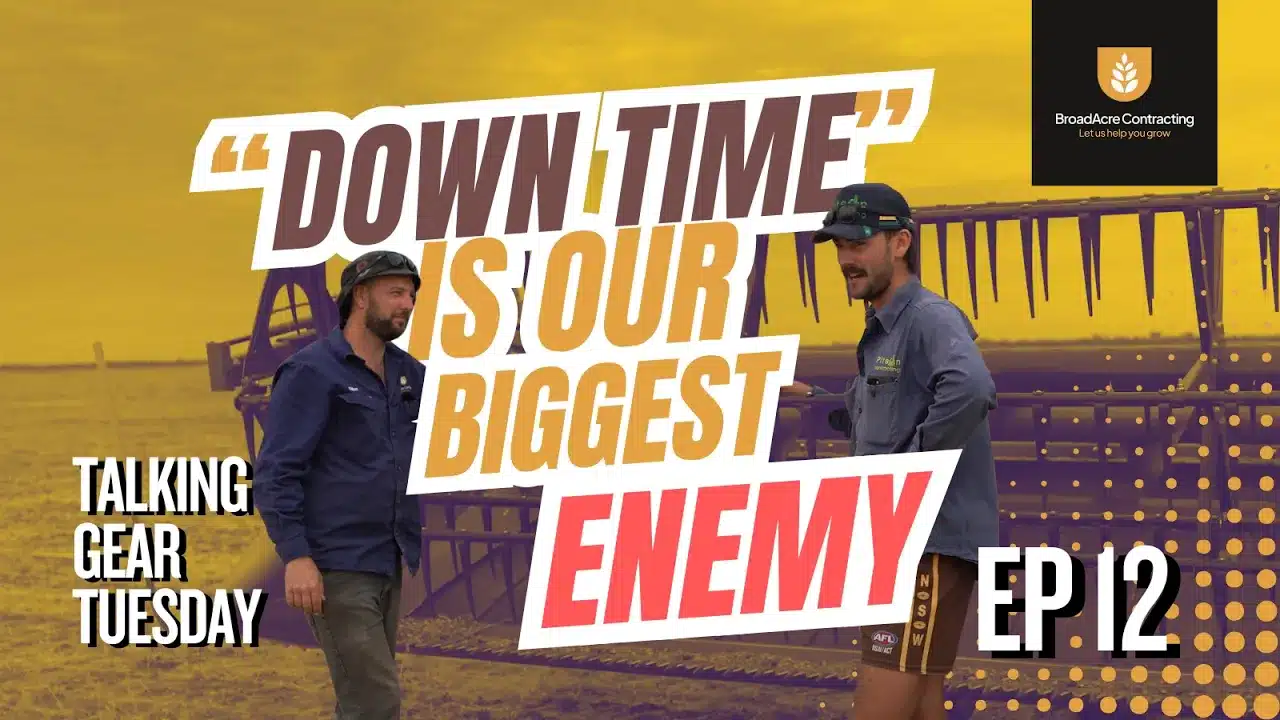
Dillon from Broadacre Contracting is up in Dirranbandi catching up with Pitson Contracting.
The Pitson team are a harvest contracting business based out of the Riverina, in a regional community called Culcairn.
If you are not familiar with Culcairn, it sits between Albury and Wagga Wagga on the Olympic Highway, smack in the middle of some of the best cropping country in southern New South Wales.
Now, let us not get too heated up, but I will put it out there: unfortunately, I cannot say much the same about the bloody roads.
Anyway, moving on.
These boys travel.
From the Dirranbandi and St George region up north, the Pitson Contracting crew can work right down through to their local region in the Riverina, covering farming communities like Holbrook and Albury, north to Junee and Temora, east to Henty and Walla Walla, and west toward Lockhart and The Rock.
Jimmy and the Pitson Contracting crew run a medium-scale harvest operation, and today we are having a yarn about maintenance, downtime, and how they keep their headers rolling no matter what gets thrown at them.
One thing I will say is, when I got out in the paddock, the gear looked clean.
And it bloody is, in the middle of harvest.
So before we dive in, if you are a grower needing a hand with your harvest program, or a contractor wanting to build your reputation and build relationships with growers, give Dillon a buzz on 0439 300 380 from 6am to 9pm.
Just a warning, he loves to have a yarn.
And if it is urgent, just ring, ring, and we will help in any way possible.
Let us yarn parts and John Deere headers.
The Pitson crew were stripping chickpeas when we caught up with them.
The boys had finished the wheat off over the previous couple of days and had a good run.
The weather had been good, with a few thunderstorms here and there, but it was a little bit unpredictable at the time.
So they were trying to punch as hard as they could, and the boys were running pretty well.
Coming up the road, the gear looked like it had just peeled out of the workshop.
Fresh as a daisy.
Jimmy said the gear is newish, but they look after it too.
Their biggest pride is keeping the gear clean, cabs clean and headers clean.
Chickies, the good old fire starters.
The boys a bit further up around Rockhampton and Emerald, QLD, were only getting 2 to 3 boxes, then had to blow down.
This is the 2025/26 harvest, and it sounded like the boys were getting over it.
I do not blame them.
Every couple of boxes is a bit full on.
I would get over it, and I would also be saying to myself, any minute now and she is show over.
Risky business, really.
Some years are worse than others, I suppose.
We see it each year.
Some years chickpeas are not too bad, then they are shocking.
It really seems to come down to the heat the crop copped and the bug pressure the plants had through the season.
The more pest pressure and heat a crop has had through its growing life, the hairier and more acidic it gets.
This is why each year is different, and I feel contractors should always ask these few questions: much bug pressure? Has she been warm?
Asking those two questions could lead to preventing machines from burning.
Now, I am not saying it should be the contractor’s responsibility to ask the grower.
The grower could also mention this to the contractor.
But honestly, it is a two-point question we all seem to miss.
Instead, we all ask each other, “I wonder how bad they will be this year?”
The reason chickies are so different and such a high risk compared to other crops is because they have an acid on them, and that acid makes the dust and residue sticky.
It clumps up and builds inside the nooks and crannies on the headers.
Then the fine, combustible dust settles on our hot spots like exhausts, manifolds and bearings.
It essentially creates an opportunity ignition point.
I often thought it was like a mildew, but turns out it is not mildew.
I thought I should mention that, because I had mistaken it.
It is an acid-coated dust. You might not have known, and now you do.
How bloody good.
Always learning, always eager, always asking questions and always getting better at what we do.
I hear a lot of fellas tell me that certain model headers are worse than others.
I do not personally know myself, as I have only really spent 4 years in the same colour.
But going out on a pretty common-sense limb here, it has to be because of the location of certain parts, or nooks and crannies.
The exhaust or exhaust manifold is a perfect example.
We all understand if residue is caught up on the exhaust or manifold, it creates a real ignition point.
But I feel there are so many variables that it is hard to bring it down to certain brand headers sparking up more than others.
Manufacturers spend millions on research and development.
Everything is placed in an area for a reason, so if an exhaust or manifold is in a more vulnerable spot on one branded header compared to another, there has to be a reason.
These things are not just slapped together.
It would be awesome if manufacturers actually explained the R&D process to us.
That in itself would be a jungle and a constant moving goalpost.
I do not feel they can get everything right, no one can.
It would be awesome if manufacturers like John Deere, New Holland, CLAAS, Case or Fendt pulled back the curtain on how they decide where the hot components go through their R&D process.
I know every member of the Broadacre Contracting community and most harvest contractors in the country would have a read of that.
I also know whatever manufacturer interacted with Broadacre Contracting and the Australian contracting sector would gain a lot of respect and trust.
For the manufacturer looking to build that, I feel there is an opportunity there that no one has indicated and utilised.
Anyhow, that turned into a real side quest.
We did not get here to talk chickies.
We got here to talk with Jimmy and the Pitson Contracting crew.
We do not really see chickies down in our area.
The Riverina, Culcairn and Holbrook regions are more mixed farming enterprises, predominantly grazing crops and cereals.
We see a lot of rotation around that 20% canola, 40 to 50% cereals, then the remainder pulses or hay and silage crops.
But obviously up north and over in South Australia, chickies are a popular choice and play a major part in rotations.
It is one of the reasons a harvest contractor like Pitson has to be so versatile.
Different crops, different regions, different headaches.
Side quest complete, moving on.
It was good to hear that the Pitson crew had managed to dodge some storms floating around.
The 2025/26 harvest did not really have much that held it back.
It came quick and was over before we knew it.
As we were coming up the laneway with our videography team, we all noticed the Pitson crew’s gear looked bloody clean.
A lot of gear does look clean, but for whatever reason, these guys’ gear just really showed it.
It is a bloody good representation, I feel.
If I see clean gear, it tells me that person or business is organised and thorough.
If I see dirty gear and dirty cabs, it tells me that you are in too much of a rush.
And if you are in too much of a rush, there is an incident or breakdown waiting to happen.
That is just me talking from experience.
I have seen it time and time again, and I have also learnt it the hard way.
Jimmy was clear that maintenance is one of the biggest things in the Pitson Contracting operation.
The workshop at home is still running during harvest.
They have a couple of good boys who are from the mines originally, including workshop managers from the mines, and a couple of the second-in-charges are as well.
The aim is to run it the same way a mining company would.
Downtime is the biggest enemy.
So they carry a lot of parts and a lot of spares.
They have four or five mechanics running around on the ground, plus a couple of boilermakers.
Anything they cannot get, they make.
If they have to, they have blokes going to Sydney, Brisbane or Melbourne, getting parts wherever they can.
They will fly parts in if they need to, just to keep the headers rolling and keep the clients happy.
Pitson Contracting is based in Culcairn, and Jimmy said they find it a good place to be situated for sourcing parts.
Jimmy hits the nail on the head.
Downtime is the biggest enemy.
Now that we are here talking about it, I feel it is a cracker of an opportunity for me to explain how I look at downtime myself.
Let us work on a Class 8 header, and let us just say that header is $650 an hour.
Every hour that machine goes down is actually converted to two hours.
So each hour is a total of $1,300.
If you are asking how that is possible, I understand why you are asking.
It is possible because that machine is now an hour behind on the current job, which means the next job or opportunity is an hour behind as well.
Please do not take this as right or wrong. It is just my approach and how I value downtime.
Everyone will be different on this, and there is no real right or wrong.
Harvest contractors have a small window, and that small window is their worst enemy but also their greatest tool.
It is bad because it means we have to get everything right to make the most of it.
But because it is a small window, it does create demand.
The next side of downtime is the pressure.
Above, I mentioned what I feel it costs an hour on a cash basis, but the next part is the pressure and the reliability cost.
Growers have a lot of risk sitting out in the paddock.
That risk, alongside the small time frame, is probably the two main drivers of the Australian contracting industry.
When gear breaks down and something like this comes up, there is always the question of how bad it is and whether we need to change our approach.
Generally, it is a loyal, open conversation between grower and contractor.
More often than not, the grower is in there helping, or his staff are.
Teamwork makes the dream work.
But if we have had a catastrophic failure that could have been prevented, we are now at a loss on that job and to that gear.
And now it leads to a question in the back of the client’s mind around reliability.
So that is another side to it, one that is a bit hard to communicate out, but I would imagine most would understand where I am going with it and why I see downtime the way I do.
I have spent a little bit of time in the mining sector, and it was not for me.
But maintenance and pre-start reporting are strict, thorough and they work.
The question I have, and should have asked at the time to Jimmy, was how did he come across this mining setup?
He was raised on the family farm, went to uni and returned.
So somewhere in there, did he do a little spell to give him the insight?
Did a mate spend some time and explain it, and he saw the value in it?
Did he just do some research and determine downtime is probably one of the most important issues to tackle, and came across the mining scheme?
How did it come to be?
I spent a bit of time in the mines.
Gave an open-cut sand mine at Mildura a go, lasted 6 months, went west and tried some drilling out of Kununurra in the Ord region of WA, even tried to go rock crushing in Leonora WA.
Mining was just not me.
It is not my style.
But where I am going here is that there are some really good systems we could take from these structures, and some I would highly suggest against.
Jimmy, if you ever come across this, give us the answers mate, because it is bloody impressive.
The Pitson crew are based out of Culcairn in the Riverina.
Culcairn, and places like our base at Corowa, even Oaklands, have a geographic advantage that most people would not think about unless they lived in the region.
Give me a chance to break it down.
Culcairn itself sits on the highway between Albury and Wagga Wagga.
You have RDO Equipment and Hutcheon and Pearce in Albury.
Albury is a central hub, and for Hutcheon and Pearce in Wagga you have the main headquarters.
Not too far to the northwest you have Griffith, once again a major parts hub.
Then, if all things fail, we have the main real hubs: Melbourne around 4 or so hours, Dubbo 5 hours, or the last real big option is Brisbane, which by air travel is probably better.
Back to Culcairn, it has some of the biggest headquarters and parts hubs all within an hour or so, north to south and west to east.
You essentially have parts availability within an hour or so drive in any direction.
Compare that to running headers up past Condobolin or out west of Hillston where you are genuinely isolated.
The boys are positioned perfectly.
Mix that type of geographic location with a team built from boilermakers and mechanics, keeping containers of parts onsite and being happy to fly parts in.
This is telling me one thing.
They have done the maths.
They know what an hour of downtime costs across their fleet, and paying for air freight is still cheaper than having headers parked up.
Jimmy is onto it. That is proper business thinking.
Here is what I want to know though.
John Deere, and whoever these boys are running, do the OEMs offer priority parts programs for harvest contractors?
I feel if they do not, they should.
A contractor spreading the word of a reliable dealer is a walking and talking billboard for the brand.
RDO, Hutchies, if you are reading this, we all want to know: what does your rapid response program look like for harvest contractors?
I would genuinely love to know, and I know other contractors would too.
A lot of opportunities are sitting out there for dealers. The question remains, who is going to see it and take it up?
In the workshop, Pitson Contracting probably has two to four diesel mechanics in there the whole time, two fitters and a couple of boilermakers.
Then they bring two boilermakers up to the harvest run with them, plus probably two to three mechanics just on field.
They do not really jump in headers all the time, but they do jump in them at night and do a bit of operating as well.
So they get the best of both worlds.
They are on the tools and they are operating.
You know, it is a pretty handy point that Jimmy makes here.
Running a team mainly built up of mechanics, boilermakers and fitters instead of just operators.
What we feel, based on what we know at Broadacre Contracting, is that a lot of successful harvest contractors are successful because they know the gear and how to fix it.
From contractors running one machine all the way through to running 10 to 15 bits of gear, even 20, the common thread is that you need the knowledge on how to keep the gear running.
There are a lot of moving parts to headers, and they will break down.
We are not guaranteed too much in life, but if you own a header you are guaranteed one thing.
You will have breakdowns.
Pitson Contracting has really nailed it down here and identified that.
They are better off running a team of qualified mechanics, fitters and boilermakers, and having them shuffle around, doing a bit of operating at night and during the day where needed.
Or in the morning, they are pre-starting the gear, checking it over and fixing it.
Running a team like this, they are not just making the gear reliable.
They are also reducing risk of stuff-ups.
I do not want to use the f word here, but I am going to.
By structuring your team like this, you are reducing fatigue and other negative impacts on your daytime crew.
They are running their 12 to 14-hour days, staying fresh, fingers on the pulse and catching soon-to-be issues.
I feel the Pitson Contracting team have a very smart approach.
Now, I know some readers will have a couple of questions here.
I know the answers already myself, and it is a big topic in ag.
It is all fine and well to say have this staff or do it like this, but where do we find the staff?
And where do we find the qualified staff?
I am going to give it to you straight.
Jump on social media and look up Broadacre Contracting, then look up Pitson Contracting.
Staff come from social media.
Now, you can get any level of staff from social media, but it is not easy trying to find qualified mechanics and the like.
Have a search through the mining industry.
Most people are only there for the money, they are unhappy, and I know most of the mine boys who come out to a harvest crew would refuse to go back to the mines if they had the choice.
Somewhere in that industry is staff for you.
Find them through social media.
If you need a hand using social media to find them, just call Broadacre Contracting.
We do it every day.
Our marketing arm solves these problems every day.
Downtime is the biggest enemy, so the Pitson team does a lot of maintenance.
That is what they do all year round: double-checking things.
Even in the mornings, the mechanics beat the header operators to the paddock.
They check over everything and then go through all the basic maintenance with the header operators as well.
They have mechanics in the field from 5:30 onwards, making sure everything is Mickey Mouse.
If they need parts, those parts are already on their way before the headers are in gear.
Off you go.
When I was a young buck, I was forced to do a heap of push-ups.
My first somewhat job was an apprenticeship as an apprentice builder, building log homes in Mansfield, VIC.
My boss at the time was employed with government as well.
Me being young and dumb, and you know the usual, I would walk past cut-offs in the yard and not pick them up.
I was told, “Get down, give us 10 mate,” then had to explain why I would walk past things that should be picked up.
Some people reading this might think that was not right.
My advice would be, if you do not think it is right, close my blogs and head off somewhere else.
The reason I say this and hit hard is that it defined me.
It actually made me.
It drilled proactiveness into me.
Most times in my life, I find myself referring back to the 7 Ps.
Prior Planning and Preparation Prevents Piss Poor Performance.
At the time of my apprenticeship, these were just words.
Now, they are everything.
The reason I ended up going down this route is that mechanics being out at the headers at 5:30am is purely that.
Prior planning and preparation prevents poor performance.
The Pitson Contracting team should really nail down a slogan based around this, honestly.
Prior planning and preparation is one of Pitson Contracting’s biggest things.
Not only with maintenance, they send a lot of parts with their headers.
They have parts boxes allocated to each header with what each machine might need, including the basics and whatever else.
Then they have a base where they have a heap of parts.
Each property will have a fair few parts.
Each service truck has a heap of parts with it.
All the other boys getting around have a heap of parts too.
You can never stock everything, but they stock a lot of it.
Having a lot of parts on hand means a lot of money rolling around.
But I feel by now we are going into a bit of a broken record, and I do not really want to come across like that to the readers.
What I want to indicate here is building your own in-house distribution parts network.
That is exactly what the Pitson Contracting team have done.
Let us make it like an onion as we peel back each layer.
Six layers of redundancy.
That means no matter where the breakdown happens, whether it is a paddock outside Walla Walla at 9pm or a property near Junee at 5:30am, there is a part within reach or something is getting reverse engineered.
The spreadsheet system is the backbone though.
Knowing what you have, where it is, and what has been used.
No guesswork.
No driving from Culcairn to Wagga for a belt that was sitting in the parts box on the header next door.
There is a lot of work in the management of all of this in its own right, and there is a lot of money being invested into this.
It just goes to show how important it is to be ready for an issue.
The Pitson crew are based out of Culcairn in the NSW Riverina, and they will travel wherever the harvest takes them.
If you need a contractor and you are from Clermont QLD, the Liverpool Downs, even Geraldton WA, reach out to Dillon from Broadacre Contracting.
This is exactly where Broadacre Contracting comes into its own.
One contractor can only be in one place at a time.
But Broadacre has verified contractors scattered right across the country.
We can cover every inch of Australia, connecting good growers with reliable contractors.
So whether it is wheat, chickpeas, canola, lentils, barley or anything else going through a front, you post the job, an instant alert goes out, and whoever is available and local will give you a bell.
That is the whole point of what we have built. Made by farmers, for farmers.
We have a very unique system here at Broadacre Contracting.
We work on core values of respect, reliability and responsibility.
We are actively seeking to build new relationships.
We want to be a part of your success story.
If you want to have a yarn about finding a reliable harvest contractor, whether you are farming around Culcairn, Henty, Walla Walla, Holbrook, Albury, Wagga Wagga, Junee, Lockhart, The Rock, Urana, Corowa, Temora or anywhere across the broadacre belt in Australia, give Dillon a call on 0439 300 380 from 6am to 9pm.
Please remember we are made by farmers for farmers.
Broadacre Contracting is here to help growers’ and contractors’ bottom line.
These resources may help growers and contractors watch the episode, find harvest contractors, post a job or understand how Broadacre helps contractors build trust and visibility.
If you are looking for harvest contractors around Culcairn, Holbrook, Wagga Wagga, Henty, Walla Walla, Lockhart, The Rock, Corowa, Temora or anywhere across the broadacre belt, Broadacre Contracting gives you a clearer place to start.
Watch the Pitson Contracting episode, browse harvest contractors or post a tender so verified contractors can see the job and contact you directly.
Pitson Contracting is a harvest contracting business based out of Culcairn in the Riverina region of New South Wales. In this Talking Gear Tuesday episode, Jimmy from Pitson Contracting talks with Broadacre about maintenance, downtime, clean gear and keeping headers rolling during harvest.
Culcairn sits between Albury and Wagga Wagga on the Olympic Highway in southern New South Wales. It is well positioned for Riverina cropping country and has strong access to regional machinery parts hubs.
Yes. The Pitson crew are based out of Culcairn in the NSW Riverina and travel wherever the harvest takes them, including northern regions such as Dirranbandi and St George.
Downtime costs more than the hourly rate of the stopped header. It also delays the current job, pushes back the next job, increases pressure on the grower and contractor, and can raise questions around reliability if the breakdown could have been prevented.
Pitson Contracting carries parts across machines, properties, service trucks and their home base so they can reduce downtime and keep headers rolling. Their approach creates layers of redundancy across the harvest run.
Headers have many moving parts and breakdowns are guaranteed at some point. A crew with mechanics, fitters and boilermakers can diagnose issues, repair gear, fabricate parts if needed and reduce the load on operators.
You can browse harvest contractor listings through Broadacre Contracting, watch contractors through Talking Gear Tuesday or post a tender so verified contractors can see the job and contact you directly.
Talking Gear Tuesday is Broadacre Contracting’s video series where we sit down with growers, contractors and ag operators to yarn about gear, businesses, risks, lessons and the real stories behind Australian agriculture.
LIVE GIVEAWAY TONIGHT AT 6PM AEST
Tune in from 5:30 PM AEST as we draw some prizes and make some announcements.
All subscribing + and growth members are automatically entered:
Facebook: fb/broadacrecontracting
YouTube: yt/@BroadacreContracting
TikTok: tktk/@broadacre_contracting
Join for a laugh and to have a yarn! Cheers.